
WEDNESDAY MARCH 7th to SATURDAY MARCH 10th.
After the Unfinished Obelisk expedition, we had an hour before boarding our Feluccas for the 3 day sail down the Nile towards Edfu. I spent a very pleasant tme in a restaurant called 'Aswan Moon' floating on the Nile opposite Elephantine Island taking in the scenery and chatting with some of the Explore Group over cold d rinks and Mint Tea (Chai be Na Na).
Aswan is similar to Luxor in that it is next to the Nile with a Corniche walkway, a Souk and plenty of small shops.
The Nile here has several islands between the banks, Elephantine Island and Kitchener Island, the scenery across the river is dominated by a big sandy rise with an ancient monument on its crest. A more modern eyesore is the Movenpick hotel on one of these islands which looks more like an industrial water tower.

The population here is more mixed and Nubians with their striking features, darker skin and bright smiles are noticable amongst the Egyptian faces. By 10am the Camel trekkers had returned via a small motorboat and met us at the Aswan Moon. We then walked along the Corniche to our waiting Felucca sail boats. The Felucca is a traditional wooden sailing boat used for many centuries. The deck was spanned with wooden planks under which we stored our heavy luggage, keeping a daysack with us for water, suncream and reading books etc. Above the planks we had soft mattresses covered with a large sheet where we could all spread out and laze around shaded from the sun by a canopy. It was really quite nice! Between the group of 20 travellers we shared 3 boats. Each boat had a crew of 2 men - all Nubians with a sense of humour! Our boat (I forgot the name of it) was captained by Hamada and his second in command called Islan ( I think). Between them they very casually and without fuss sailed the boat perfectly, whilst making us hot tea or settling down to play chess with each other - keeping a foot on the tiller and a glance at the sails!

Our first brief stop after setting sail was to a small island nearby for the Police to check the paperwork for all three boats before allowing us to continue. This didn't take long and we were soon making good progress on the river in convoy, zig zagging from one bank to the other into the wind, but with the Nile current in our favour.

The initial buzz and excitement of leaving the dusty shores for water lasted for a few hours as we had plenty to look at - passing ships, bridges, wildlife on the shore, the sailing itself, the rush of the water along the hull of the boat, waving passengers from their cruise liners and the scenery on land. Aswan faded into the distance and around lunchtime the three boats moored onto a sandy bank with tall dunes for a rest, toilet stop and food.

This was our first experience of 'Freestyle' toileting and I had no problem with it, but it was tricky to find a secluded spot as there wasn't much cover and the sand was boiling hot! Meals for the whole group took place on the largest felucca with food laid out in the middle in a help yourself buffet.

A typical lunch comprised pitta bread, chopped salad veg, fetta cheese, some fruit and a hot drink. Dinner was hot pasta or rice & potatoes with a meat dish followed by oranges.


A full afternoon of sailing brought us at dusk to our first camping spot. The wind had dropped so we had to drift to the bank for over an hour and it was dark when we arrived. Supper was followed by a large fire on the bank and Nubian music and dancing. It was a lot of fun! Our tour leader had the task of constructing our toilet on the bank. This was a loo complete with lid over a dug out hole surrounded by a low level tent. It wasn't very glamorous! The loo travelled with us tied to the boat which looked hilarious!

Sleeping on the Felucca was fine, warm and comfortable, broken only by the rocking of the water as the large cruisers went by through the night heading south to Aswan.

The next few days passed by in a similar pattern. Awake at dawn, coffee and biscuits made by Islan. An early morning exploration of the river bank, a group breakfast of bread, jam, eggs, fruit and hot drinks. Morning sailing, A Temple visit followed by lunch, then more sailing, setting up camp, supper, fire, music and dancing.
Each of our stops has it's own memory. The First night - stray dogs running around on the bank and our first 'environmental toilet'

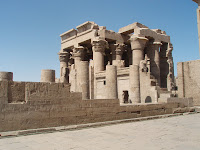
Second Day - Kom Ombu Temple - meaning ' Land of Gold' this amazingly well preserved Greco/Roman temple was built around 300BC for 2 gods - Sobek (crocodile god) and Horus. Each having hieroglyphs and reliefs on separate sides of the temple. we were also plagued here by local kids selling jewellery!

Later that day we also passed the EXPLORE Cruise boat DOMA going South and waved at our week one buddies from our Feluccas!

Second night - A very noisy buffalo who was less than pleased to see us!
Third day - Swimming in the Nile - a chance to wash my hair too!


Another very unhappy buffalo which tried to get inside one of the boats on arrival! there were some very sweet donkeys as well though.


Saturday morning - visit to Edfu Temple. One of the best preserved and imposing temples. Scenery - wonderful Nile scenes through the day, and sunrise & sunset. Dramatic views of the mountains, palm trees, crops on the riverbank, donkeys, kids, farmers and locals waving from the shore.


The wildlife was wonderful too. I saw lots of Kingfishers which are larger than British ones with black and white feathers and they hover above the water. The nests in the dry mud of the river bank were visible all the way along the Nile.
At dusk I heard the sound of Egrets, frogs, moorhens and other birds. Through the night you could make out the distant sound of the Mezzuin callng to prayer. Overall it was a very special experience.

On Saturday morning we left our overnight camp and drifted together a very short distance to the edge of Edfu. Our luggage came of each boat and we said thank you and goodbye to the crews. Mini buses took us along bumpy tracks through tiny village streets to the centre of Edfu - a busy town and a hub for the cruise ships.

We visited the large and impressive EDFU Temple - built in the Ptolomeic period and dedicated to Horus. With just 45 minutes here I took time walking the outside walls which carry huge carvings over 15m high. It was busy with tourists and not so easy to appreciate the quiet areas. If I ever return to Egypt this is one temple I'll try to visit again. There is so much to see here, and I'd like to be able to understand the story behind some of the murals and carvings. Inside the temple were shrines decorated with hieroglyphs lit by orange spotlights for maximum effect.


It was however, the best temple we had visited thus far (better still to come) Before coming to Egypt I had not fully understood that each temple and monument would have been colourful. I was aware of the carvings, hieroglyphs and obelisks, but in ancient times, these would have been brightly painted in Red, Blue, Green, Gold. In places around the temples today you can see traces of this colour. The original effect must have been stunning.

BACK TO LUXOR AGAIN !
Mid Morning we left Edfu in our mini buses to join the Police convoy north to Luxor. This relatively short journey brought us back to our Hotel Emilio in the bustling and dusty Luxor by lunchtime. The peace of the river shattered by the noise and crowded streets! The aroma of dirt, sewerage, spices, horses and car fumes was quite pungent!
It was good to be back here and I was looking forward to free time over the weekend to explore Luxor Temple, the museum, Winter Palace and my hot air balloon ride!


 WEDNESDAY MARCH 7th to SATURDAY MARCH 10th.
After the Unfinished Obelisk expedition, we had an hour before boarding our Feluccas for the 3 day sail down the Nile towards Edfu. I spent a very pleasant tme in a restaurant called 'Aswan Moon' floating on the Nile opposite Elephantine Island taking in the scenery and chatting with some of the Explore Group over cold d rinks and Mint Tea (Chai be Na Na).
Aswan is similar to Luxor in that it is next to the Nile with a Corniche walkway, a Souk and plenty of small shops.
The Nile here has several islands between the banks, Elephantine Island and Kitchener Island, the scenery across the river is dominated by a big sandy rise with an ancient monument on its crest. A more modern eyesore is the Movenpick hotel on one of these islands which looks more like an industrial water tower.
WEDNESDAY MARCH 7th to SATURDAY MARCH 10th.
After the Unfinished Obelisk expedition, we had an hour before boarding our Feluccas for the 3 day sail down the Nile towards Edfu. I spent a very pleasant tme in a restaurant called 'Aswan Moon' floating on the Nile opposite Elephantine Island taking in the scenery and chatting with some of the Explore Group over cold d rinks and Mint Tea (Chai be Na Na).
Aswan is similar to Luxor in that it is next to the Nile with a Corniche walkway, a Souk and plenty of small shops.
The Nile here has several islands between the banks, Elephantine Island and Kitchener Island, the scenery across the river is dominated by a big sandy rise with an ancient monument on its crest. A more modern eyesore is the Movenpick hotel on one of these islands which looks more like an industrial water tower.
 The population here is more mixed and Nubians with their striking features, darker skin and bright smiles are noticable amongst the Egyptian faces. By 10am the Camel trekkers had returned via a small motorboat and met us at the Aswan Moon. We then walked along the Corniche to our waiting Felucca sail boats. The Felucca is a traditional wooden sailing boat used for many centuries. The deck was spanned with wooden planks under which we stored our heavy luggage, keeping a daysack with us for water, suncream and reading books etc. Above the planks we had soft mattresses covered with a large sheet where we could all spread out and laze around shaded from the sun by a canopy. It was really quite nice! Between the group of 20 travellers we shared 3 boats. Each boat had a crew of 2 men - all Nubians with a sense of humour! Our boat (I forgot the name of it) was captained by Hamada and his second in command called Islan ( I think). Between them they very casually and without fuss sailed the boat perfectly, whilst making us hot tea or settling down to play chess with each other - keeping a foot on the tiller and a glance at the sails!
 Our first brief stop after setting sail was to a small island nearby for the Police to check the paperwork for all three boats before allowing us to continue. This didn't take long and we were soon making good progress on the river in convoy, zig zagging from one bank to the other into the wind, but with the Nile current in our favour.
 The initial buzz and excitement of leaving the dusty shores for water lasted for a few hours as we had plenty to look at - passing ships, bridges, wildlife on the shore, the sailing itself, the rush of the water along the hull of the boat, waving passengers from their cruise liners and the scenery on land. Aswan faded into the distance and around lunchtime the three boats moored onto a sandy bank with tall dunes for a rest, toilet stop and food.
 This was our first experience of 'Freestyle' toileting and I had no problem with it, but it was tricky to find a secluded spot as there wasn't much cover and the sand was boiling hot! Meals for the whole group took place on the largest felucca with food laid out in the middle in a help yourself buffet.
 A typical lunch comprised pitta bread, chopped salad veg, fetta cheese, some fruit and a hot drink. Dinner was hot pasta or rice & potatoes with a meat dish followed by oranges.

 A full afternoon of sailing brought us at dusk to our first camping spot. The wind had dropped so we had to drift to the bank for over an hour and it was dark when we arrived. Supper was followed by a large fire on the bank and Nubian music and dancing. It was a lot of fun! Our tour leader had the task of constructing our toilet on the bank. This was a loo complete with lid over a dug out hole surrounded by a low level tent. It wasn't very glamorous! The loo travelled with us tied to the boat which looked hilarious!
 Sleeping on the Felucca was fine, warm and comfortable, broken only by the rocking of the water as the large cruisers went by through the night heading south to Aswan.
 The next few days passed by in a similar pattern. Awake at dawn, coffee and biscuits made by Islan. An early morning exploration of the river bank, a group breakfast of bread, jam, eggs, fruit and hot drinks. Morning sailing, A Temple visit followed by lunch, then more sailing, setting up camp, supper, fire, music and dancing.
Each of our stops has it's own memory. The First night - stray dogs running around on the bank and our first 'environmental toilet'
The next few days passed by in a similar pattern. Awake at dawn, coffee and biscuits made by Islan. An early morning exploration of the river bank, a group breakfast of bread, jam, eggs, fruit and hot drinks. Morning sailing, A Temple visit followed by lunch, then more sailing, setting up camp, supper, fire, music and dancing.
Each of our stops has it's own memory. The First night - stray dogs running around on the bank and our first 'environmental toilet'
 Second Day - Kom Ombu Temple - meaning ' Land of Gold' this amazingly well preserved Greco/Roman temple was built around 300BC for 2 gods - Sobek (crocodile god) and Horus. Each having hieroglyphs and reliefs on separate sides of the temple. we were also plagued here by local kids selling jewellery!

 Later that day we also passed the EXPLORE Cruise boat DOMA going South and waved at our week one buddies from our Feluccas!
 Second night - A very noisy buffalo who was less than pleased to see us!
Third day - Swimming in the Nile - a chance to wash my hair too!
Second night - A very noisy buffalo who was less than pleased to see us!
Third day - Swimming in the Nile - a chance to wash my hair too!

 Another very unhappy buffalo which tried to get inside one of the boats on arrival! there were some very sweet donkeys as well though.
 Saturday morning - visit to Edfu Temple. One of the best preserved and imposing temples. Scenery - wonderful Nile scenes through the day, and sunrise & sunset. Dramatic views of the mountains, palm trees, crops on the riverbank, donkeys, kids, farmers and locals waving from the shore.

 The wildlife was wonderful too. I saw lots of Kingfishers which are larger than British ones with black and white feathers and they hover above the water. The nests in the dry mud of the river bank were visible all the way along the Nile.
At dusk I heard the sound of Egrets, frogs, moorhens and other birds. Through the night you could make out the distant sound of the Mezzuin callng to prayer. Overall it was a very special experience.
The wildlife was wonderful too. I saw lots of Kingfishers which are larger than British ones with black and white feathers and they hover above the water. The nests in the dry mud of the river bank were visible all the way along the Nile.
At dusk I heard the sound of Egrets, frogs, moorhens and other birds. Through the night you could make out the distant sound of the Mezzuin callng to prayer. Overall it was a very special experience.
 On Saturday morning we left our overnight camp and drifted together a very short distance to the edge of Edfu. Our luggage came of each boat and we said thank you and goodbye to the crews. Mini buses took us along bumpy tracks through tiny village streets to the centre of Edfu - a busy town and a hub for the cruise ships.
 We visited the large and impressive EDFU Temple - built in the Ptolomeic period and dedicated to Horus. With just 45 minutes here I took time walking the outside walls which carry huge carvings over 15m high. It was busy with tourists and not so easy to appreciate the quiet areas. If I ever return to Egypt this is one temple I'll try to visit again. There is so much to see here, and I'd like to be able to understand the story behind some of the murals and carvings. Inside the temple were shrines decorated with hieroglyphs lit by orange spotlights for maximum effect.

 It was however, the best temple we had visited thus far (better still to come) Before coming to Egypt I had not fully understood that each temple and monument would have been colourful. I was aware of the carvings, hieroglyphs and obelisks, but in ancient times, these would have been brightly painted in Red, Blue, Green, Gold. In places around the temples today you can see traces of this colour. The original effect must have been stunning.
 BACK TO LUXOR AGAIN !
Mid Morning we left Edfu in our mini buses to join the Police convoy north to Luxor. This relatively short journey brought us back to our Hotel Emilio in the bustling and dusty Luxor by lunchtime. The peace of the river shattered by the noise and crowded streets! The aroma of dirt, sewerage, spices, horses and car fumes was quite pungent!
It was good to be back here and I was looking forward to free time over the weekend to explore Luxor Temple, the museum, Winter Palace and my hot air balloon ride!
BACK TO LUXOR AGAIN !
Mid Morning we left Edfu in our mini buses to join the Police convoy north to Luxor. This relatively short journey brought us back to our Hotel Emilio in the bustling and dusty Luxor by lunchtime. The peace of the river shattered by the noise and crowded streets! The aroma of dirt, sewerage, spices, horses and car fumes was quite pungent!
It was good to be back here and I was looking forward to free time over the weekend to explore Luxor Temple, the museum, Winter Palace and my hot air balloon ride!


