
MONDAY MARCH 12th - THE WESTERN DESERT
We left Luxor after breakfast in a comfortable mini bus, picking up 2 new travellers from the Cruise ship 'DOMA' - Mary Ann from Canada and Pauline from Bath. This final leg of the tour comprised 12 travellers (6 from the the original week) a tour guide (Tarek) a bus driver (Arden) and a policeman to protect us from stuff. We headed out of Luxor via the only bridge crossing the Nile about 8 miles south. Driving West we soon left the green lushness of the Nile valley behind us and entered a very dry and barren landscape. The Western desert is part of Egypt and the massive Sahara desert and not much is known of its civilisations before 1000BC and the New Kingdom. Over the course of 1500 years the Pharaohs, Llibyan kings, Persian kings and the Romans all prospered in the area with christianity arriving in AD 390, it's now largely Moslem.
There wasn't much to see on our 4 hour journey to the first Oasis city 'Kharga'. The Western Desert region is vast and sparsely populated, except for in areas where there is a natural water source. This occurs in half a dozen places where the land lies below sea level. I had a romantic notion of an Oasis being a watering hole emerging from the sand dunes surrounded by palm trees, bedouin tents, camels and donkeys. The reality isn't quite like that! Kharga is 60m below sea level and is a built up area over 100 miles long, like any other city or large town. The Egyptian government is trying to pursuade more people from the overcrowded Nile valley to settle and work in the Western Desert. The residents here have only recently been subjected to tourists and their approach to us is more reserved and curious. As well as coming in from Cairo, Luxor and other places, many of the locals are descended from Libyans. Farming is the main occupation, and the region is famous for dates & fruit and vegetables which are exported as well as supplying Egypt. Minerals are mined from the desert too.
As ever, there are police checkpoints across the route, some in very, very remote places and I wondered just how long the policemen spend here before going totally bonkers from the solitude!
It's strange to drive for hundreds of miles through barren desert and then find yourself in a well populated city with hospitals, police stations and shops. There are only two trains out of here every week bringing supplies or taking people to Aswan.

Our first hotel on Monday night ina remote desert area just outside Kharga was a pretty but rundown 'village' of painted mud brick houses amidst a flower garden. We hiked through the sand to a nearby temple 'Qasr el Ghueida' (Fortress of the beautiful garden) - on a hill dating back to Persian times (500BC). This was almost a ruin but still retained some original hieroglyphs from the Persian king Darius honoring the pharaonic gods. The temples was surrounded by a mud brick fortress wall. The whole area was open to walk around it was crumbling away in front of our eyes. On the hill were remains of ancient pottery used for eating and then smashed - thousands of years old and just lying on the ground! Had this site been in the UK it would be surrounded by railings no doubt. The temple lies on the ancient '40 mile road' so named for the time it would take to reach the Egyptian capital.

Back at the hotel for a shower - (I was reminded how precious the water is here - it came out in a brown trickle!) then dinner at the hotel which was served by a young boy and a few helpers - the beef seemed more like mutton to me but it was a fulfilling meal. Tarek gave us a desert briefing in the bar (a large round room with mud walls, date palm roof, sand floor, dance stage and pool table -it hardly ever rains here). An early night was in order and I had the best night of sleep since arriving in Egypt.
TUESDAY MARCH 13th
I had a lie in! I actually managed to sleep until 8.30am, it was a cool night and a comfy bed - heaven!
After breakfast (bread, jam, eggs, tea- the usual!) we left in our bus to visit local monuments before heading to the next oasis. First was Hibis Temple - another Darius construction and more impressive than Qasr el Gueida.

This stone temple looked more Egyptian in style and appeared in good condition. It was undergoing renovation works and not open fully for us to visit. We were told it was being rebuilt on this original site by an American University project after they returned it here because they thought it best to move it to another location to prevent flood damage only to find the new location equally flooded (yes really!). After Hibis, we stopped at an intriguing necropolis of mud brick christan tombs at el Bagawat dating back to the 4th & 5th Centuries. Small in size, the tombs are all different in design,some containing amazing old testament frescos over 1400 years old and remains of human burials.

In Kharga, we stopped for lunch on a busy road at a restaurant which looked like an untidy garage but served pretty good food! 'Ahmed Hamdy' seemed to have a reputation and his place is used by a few travellers. We were to go there again before leaving the oasis.

The afternoon drive took us to the meeting point for our overnight camp in the desert. The final phase of the journey was on Camels, not tourist camels, but genuine Bedouin family camels. We jumped on the back of a pickup truck and hung on for a bumpy ride to the camel 'depot' which turned out to be a shaded area in an otherwise featureless sand dune desert with views off into th distance of date palms and mountains - Much more like the desert Oasis I had imagined!
The camels were all 'laydeez' some with babies in tow and most of them pregnant again. The wear no bridles on their heads and we sat on padded cloth saddles strapped on behind their hump. It was comfortable, but with no means of control you were totally in their hands.

The camels know the way of course and our Bedouin friends walked on foot keep the camels in order. The ride was great! The sun was going down, the dunes were spectacular and apart from the smell coming from the camels it was amazing. The babies kept getting left behind and made mewing noises to find their mums - who replied (told them off I think!) with gutteral moos! Really sweet!
On arrival at camp, the 'non camel' riders had got there by truck and greeted us on foot. I held on whilst my camel lay down for me to get off and before long the whole herd galloped off into the sunset (literally) to fnd a spot not far off for the night.
The campsite was in the middle of nowhere in the lea of a sand dune for shelter from the winds, apart from that, nothing to see except sand. Our 'loos' were freestyle in the sand - watching out for scorpions and horn vipers! The girls found a bush over the top of the dune which offered some privacy.


As the sun set many of us sat on the high point of the dune for photos and a chat. Then a hot dinner around a campfire, followed by Libyan/Bedouin music and dancing and into my sleeping bag for a s=chilly night under the stars.

WEDNESDAY MARCH 14th
Woke up at sunrise, the campfire was burning again and our Bedouin hosts were busy making tea and bread on the fire. The usual jam, eggs, coffee got everyone up and about and after a short walk in the dunes to stretch the legs we said goodbye and left on the pickup truck bumping across the sand. We crested a dune and approached a farmed area of crops to find the road was dug up and an irrigation channel in the way. It was all hands on deck to cover the water with palm leaves and bark to enable the truck to drive over - which it did to a big cheer!

Back at the bus, the tourism manager for the region joined us to guide us around an early Islamic mud brick village on a hill at El Qasr- very quaint with narrow streets and higgledy piggledy homes stacked one on top of another. It's not lived in today, but was a great example of how life was lived centuries ago. After that we called into a small but excellent 'ethnographic museum' to see artefacts from the traditional oasis lifestyle.

A short drive later we were delivered to the site of a hot spring to enjoy a mineral bath for an hour and then back to Ahmed Hamdy for another good lunch before hitting the road to Farafra.

We had a long drive ahead, some 300miles to reach Farafra Oasis. On the way we stopped to view the GREAT SAND SEA part of the Libyan desert at the edge of the Sahara and stretches for 500 miles before reaching the border with Libya and yet more desert beyond that. It is a desolate place and the mirage effect did make it appear to be a sandy beach with a shimmering sea in the distance. During our monotonous drive we had to slow down whilst a herd of camels were driven across the road on their journey across the desert.


At a coffee stop on the way, the girls agreed that the toilet was horrid so wandered into the fields nearby instead. Our police guide came to make sure we were alright and stood guard with his back turned - the first time I've had an armed escort to wee in a field! (see photo)
Our hotel in Farafra was superb with comfortable Bedouin style room, with split level twin beds and a chance to shower and freshen up after camping and mud baths. Dinner was spaghetti and a bit bland but Ok. I had a good night on a double mattress under a mosquito net.
THURSDAY MARCH 15th
We had a slow morning at the hotel in Farafra (Badiwaya) with a shortwalk to a local market, art gallery and chance to buy gifts. After lunch at the restaurant we had 2 hours to rest and I caught up with my Wilbur Smith Egyptian novel (Seventh Scroll) until the bus was ready to go.


WHITE DESERT CAMP
Our next stop was to the WHITE DESERT for an overnight camp. Within an hour we had stopped on the deset road to meet up with 2 jeeps and transfer our overnight bags. The jeeps drove us deep into the White Desert, where one broke down! After much debate amongst the drivers another vehicle was summoned and we were back on our way. By now, the sun was dipping, casting shadows across the desert landscape which is made up of chalk deposits sculpted by the wind over thousands - if not millions of years and peppered with lumps of black volcanic rock across the sand.

The effect reminded me of an iceberg sea. Some of the shapes resemble animals, we saw a horse head, chicken and mushroom and I even found one which looked liked a muffin dripping with a frosted topping! or maybe it was a mirage?!
We were dropped off on foot to explore the shapes and meet at the camp - with the advice to 'keep walking in a straight line for half an hour' and sure enough we all found the camp and no-one got lost - amazing!

This camp was by far the best - set in a remote landscape miles from civilization, surrounded by wierd chalk shapes, sand dunes, rough vegetation and a stunning sunset. As sunset approached almost everyone took the opportunity for a quiet moment of reflection among the dunes, or far off amongst the chalk shapes. I chose to climb a chalk shape near to camp and watched my last sunset in Egypt. Our hosts had prepared a wonderful hot meal and we sat near to the fire as the desert temperatures dropped and the stars came out.


We were joined by a desert fox who must have visited us again in the night as his prints were everywhere the following morning. We slept in large tents to stay warm and I woke up at 6am whilst everyone else was still sleeping. I crept outside and walked about half a mile to sit and watch the sunrise. I was completely alone.

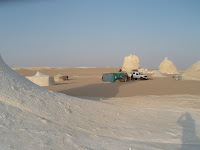

We had our final breakfast at camp and left the park in the jeeps - the drivers having fun bouncing us around and dodging obstacles on our way back to the bus which waited for us on the main desert road to take us to Cairo.

FRIDAY MARCH 16th
The atmosphere on the bus was subdued, partly tiredness and also the preparation to go back to the UK. We had a long, long drive to reach Cairo and stopped off for some extra sites along the way including an ancient burial site where over 2000 'golden' mummies were found (we saw 5 in a museum which was more like a shed!) These were Greek in their style of decoration each having a gilded mask and very badly preserved. We went inside some small tombs from the 26th Dynasty and saw our last ancient Egyptian murals. Stopped at the 'Crystal Mountain' which didn't sparkle as much as I had hoped, but was a chance to stretch our legs.


Then we had a boring featureless journey through the desert to the edge of Cairo.
We approached Cairo from the West via a newly developing region called 'October 6th'. It reminded me of silicone valley in the USA with shiny office buildings, universities and apartments.
Before long we arrived at The President hotel for our last night. I shared with Mary Ann who went with a small group to the Souk for last minute shopping in the Islamic quarter. I repacked my bags for the return trip and we all met up again for our last supper right next to the pyramids in Giza. It was a good meal and a chance to see some other people from our first week. It was hugs all round as we said our goodbyes back at the hotel - thenbed before another final early start to the airport.

SATURDAY MARCH 17th - HOME!
Breakfast in the hotel at 5.30am, all I managed was a coffee and one mouth of croissant. A group of us were all on the same flight and the bus dropped us at the airport and we checked in together. Our 9.30am flight was delayed a little and in any case we had almost 2 hours to kill in the terminal. I took the chance to buy tacky souvenirs to use up some small currency. Then all too soon we were on board and flying home as the rain poured down - how symbolic!
TOP TEN FAB THINGS FROM THE TRIP
1. The ancient history, Temples and Tombs
2. The Nile sunsets and sunrises from a Felucca
3. The snorkelling and hot air ballooning
4. The Sites, Smells and Sounds of Egyptian life in the Nile Valley
5. Freshly made Falafel & fruit juices
6. Mint Tea & Sheesha
7. Happy, Smiley People
8. Diverse and dramatic Scenery
9. Camping in the deserts
10.Spending time with great people
SUMMARY
I had a great time all the time (almost) and saw and experienced some incredible things.
Would I go back? In short , YES, but not for a while. There ae still things left to see in Luxor and Alexandria. The new museum at Giza, the fresh tombs at Gurna and whatever else is discovered in future. I would go back to the Red Sea for a snorkelling and beach holiday too.
Egypt has a lot to offer and is not disappointing, go there if you ever get the chance

 SUNDAY MARCH 11th
LUXOR TEMPLE
After breakfast back at the hotel, I met Alan & Jan again at 9am for a tour of the LUXOR Temple complex. This was close to our hotel so an easy walk. At this time of the day it was already quite busy and without the benefit of a guide we were left to fathom the meaning of the pylons, obelisks, statues, columns, frescos, shrines and hieroglyphs. I have read up about it since though! Luxor temple was dedicated to the god Amun and aplace to celebrate the festival of Ope. Linked to Karnak temple since the 4th Century BC by a long avenue of sphinxes of which only 37 survive today on each side before hitting a wall with the buildings of modern Luxor blocking the way to Karnak. There has been some recent digging (visible from our hotel) to uncover more of the sphinxes.
SUNDAY MARCH 11th
LUXOR TEMPLE
After breakfast back at the hotel, I met Alan & Jan again at 9am for a tour of the LUXOR Temple complex. This was close to our hotel so an easy walk. At this time of the day it was already quite busy and without the benefit of a guide we were left to fathom the meaning of the pylons, obelisks, statues, columns, frescos, shrines and hieroglyphs. I have read up about it since though! Luxor temple was dedicated to the god Amun and aplace to celebrate the festival of Ope. Linked to Karnak temple since the 4th Century BC by a long avenue of sphinxes of which only 37 survive today on each side before hitting a wall with the buildings of modern Luxor blocking the way to Karnak. There has been some recent digging (visible from our hotel) to uncover more of the sphinxes.
 Luxor temple was mostly built by Amenhotep III in the 18th Dynasty (C1350BC) and added to by Rameses II in the 19th Dynasty. The 2 giant statues which guard the entrance are of him as were the pylons which depict his battle with the Hittites at Qadesh in 1274BC. There were many other statues and a pair of obelisks - only one remains and the rest of the pieces are now in Paris - the obelisk in the Place de la Concorde.
 The temple was home to the Gods Mut (wife of Amun) and her son Khonsu - the statue of Amun Ra lived in Karnak and was brought here to join his family during the festival. Inside the entrance is a hall of columns added by Hatshepsut and strangely a Mosque from the 12th century. Further inside is a staus of Tutankhamun and his wife before entering the Hypostyle hall of papyrus columns, leading to another court for Amenophis III. Alexander the Great also added his own shrine to the temple. In the Roman period the temple was used to worship Emperor Constantine (AD 312-337) and an area of hieroglyphic plaster depicting Amenhotep III was smoothed over and replaced with a fresco of the Emperor and his court.


 TOMBS OF THE WORKERS
At noon we joined the whole group for a trip back across the river to the west bank and the Tombs of the Workers. This site near to the Valley of the Kings was home to hundreds of skilled craftsmen who designed, dug, plastered and decorated the tombs for the Pharaohs.
TOMBS OF THE WORKERS
At noon we joined the whole group for a trip back across the river to the west bank and the Tombs of the Workers. This site near to the Valley of the Kings was home to hundreds of skilled craftsmen who designed, dug, plastered and decorated the tombs for the Pharaohs.

 These workers tombs date from thegolden age of Egypt between 1500BC and 1000BC also known as the New Kingdom when all the great Pharaohs lived during the 18th, 19th & 20th dynasties. The tomb workers were not slaves but highly skilled and valued employees of the king. They lived and worked in the valley with little time off, but when they did have free time it was used to build their own tombs. The tombs which remain today are mostly in a poor condition, but 2 well preserved tombs remain and are open to the public. The workers saved the best for themselves and decorated their own tombs with incredible images of the afterlife and their hopes for life in eternal paradise. The quality of the artwork and their colours take your breath away. These photos are from the postcards I bought since cameras were not allowed.
 the tombs we entered were at the bottom of short but steep steps and small but what they lacked insize they made up for in quality. It's hard to imagine that these tombs are over 3000 years old although little remains of the village of mudbrick houses alongside the tombs.
 MEDINET HABU - MORTUARY TEMPLE OF RAMESES III (c. 1184-1153BC)
Our final temple in Luxor was the best and not one which is often visited by the tourists. Built for the 70 day mummification rituals for Rameses III it is a funerary temple dedicated to the achievements of his reign. It's located on the west bank at Medinet Habu and is the biggest standing temple away from the noise of Luxor and with a rocky backdrop it makes for a tranquil and atmospheric location.
MEDINET HABU - MORTUARY TEMPLE OF RAMESES III (c. 1184-1153BC)
Our final temple in Luxor was the best and not one which is often visited by the tourists. Built for the 70 day mummification rituals for Rameses III it is a funerary temple dedicated to the achievements of his reign. It's located on the west bank at Medinet Habu and is the biggest standing temple away from the noise of Luxor and with a rocky backdrop it makes for a tranquil and atmospheric location.

 Rameses III was the last great pharaoh of Egypt and won many battles against invaders. The entrance walls are unusal in that they follow the Syrian style and surrounded by a mudbrick fortification wall. On the massive pylons are depictions of the king smiting his enemies and the heads of his enemies are used as steps on the upper levels of the entrance. Inside, his victory against the Libyans is shown by several graphic scenes of prisoners having their hands. tongues and 'manhood' removed to count their numbers. Many of the scenes inside show Rameses honouring the gods - primarily Amun. The temple roof is missing but the preservation of the colours and carvings into the stone and plaster are breathtaking. I hope the photos do it justice. I've added a close up of Rameses cartouche.


 There are many more temples in and around Luxor and the west bank and I'd like to go back one day and visit them, as well as the new excavations under Gurna, and the tombs in the valley which were closed (Seti I, Ramses II, Hatshepsut) so I've plenty of reasons to go back!
Once we had returned to the east bank in our motorboat, some of us called in to visit the 'week one' Explorers on their cruise ship DOMA which was back from Aswan and moored nearby. We had a tour of their ship and stories of their antics aboard which all sounded fun. I was happy to have chosen the Felucca though. The others went back to the hotel but I stayed with them until 6.30pm then walked alone to the restaurant for our final group dinner before the final week of our tour into the Western Desert.
There are many more temples in and around Luxor and the west bank and I'd like to go back one day and visit them, as well as the new excavations under Gurna, and the tombs in the valley which were closed (Seti I, Ramses II, Hatshepsut) so I've plenty of reasons to go back!
Once we had returned to the east bank in our motorboat, some of us called in to visit the 'week one' Explorers on their cruise ship DOMA which was back from Aswan and moored nearby. We had a tour of their ship and stories of their antics aboard which all sounded fun. I was happy to have chosen the Felucca though. The others went back to the hotel but I stayed with them until 6.30pm then walked alone to the restaurant for our final group dinner before the final week of our tour into the Western Desert.


